



Top Ayurvedic Medicine Manufacturers in India: A Guide to Quality & Third-Party Manufacturing
Finding reliable ayurvedic medicine manufacturers in India is an important step for businesses planning to launch or expand an Ayurvedic and herbal product brand. From selecting quality ingredients to maintaining consistent formulations, packaging, testing, and regulatory compliance, the right manufacturing partner can have a major impact on product quality and brand credibility.
India has a well-established Ayurvedic manufacturing ecosystem, supported by regulatory requirements for licensing, Good Manufacturing Practices (GMP), and applicable pharmacopoeial quality standards. The Ministry of AYUSH states that manufacturers must follow prescribed licensing requirements and GMP provisions for Ayurvedic medicines.
For entrepreneurs, startups, wellness businesses, and established brands, third-party Ayurvedic manufacturing can provide a practical way to develop and manufacture products without investing in their own manufacturing infrastructure.
What Is Ayurvedic Third-Party Manufacturing?
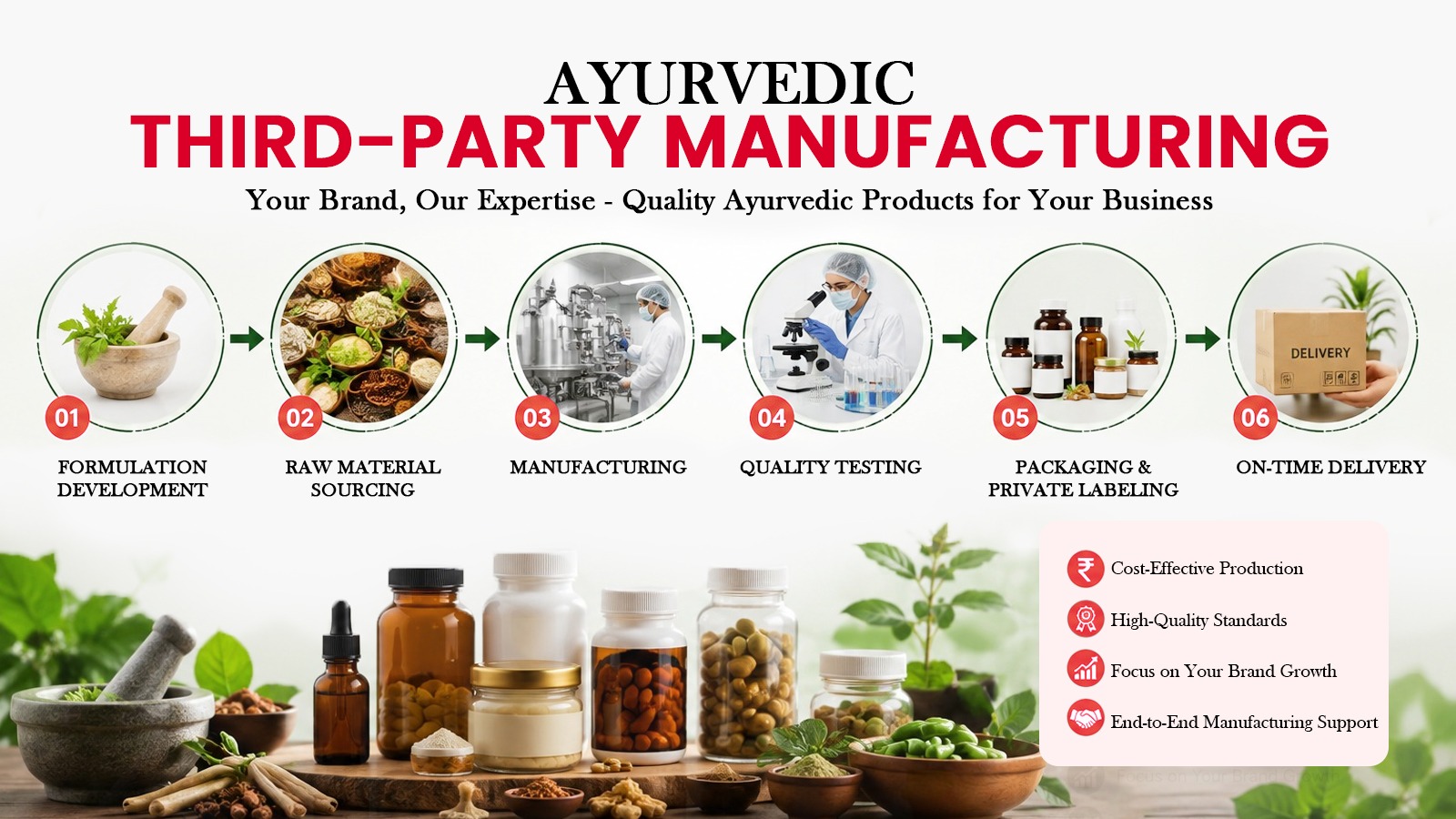
Third-party manufacturing is a business model in which a specialized manufacturer produces Ayurvedic products for another company or brand.
Instead of establishing a complete manufacturing facility, the brand can work with an experienced manufacturing partner for activities such as:
- Product formulation and development
- Raw material sourcing
- Manufacturing and processing
- Quality control and testing
- Filling and packaging
- Labelling support
- Batch production
- Product documentation
- Product delivery
This allows businesses to concentrate more on branding, marketing, distribution, and customer acquisition while the manufacturing partner manages the production side.
Why Choose Ayurvedic Medicine Manufacturers in India?
India has a long-standing tradition of Ayurveda combined with a growing modern herbal and wellness industry. Choosing an experienced Indian manufacturer can offer several advantages.
1. Access to Ayurvedic Expertise
Experienced manufacturers understand traditional Ayurvedic formulations, herbal ingredients, dosage forms, and manufacturing processes. This knowledge can help brands develop products that align with their intended market and product positioning.
2. Diverse Product Options
Depending on the manufacturer's capabilities, businesses can explore different Ayurvedic product formats, including:
- Tablets
- Capsules
- Powders
- Syrups
- Herbal oils
- Churnas
- Extracts
- Wellness products
- Herbal personal-care products
The available product categories depend on the manufacturer's licenses, facilities, and manufacturing capabilities.
3. Cost-Effective Production
Setting up an independent manufacturing facility requires significant investment in land, equipment, personnel, quality-control infrastructure, licensing, and ongoing maintenance.
Third-party manufacturing can reduce the need for this infrastructure investment and allow businesses to start with a more focused production strategy.
4. Scalability
A suitable manufacturing partner can help businesses increase production as demand grows. This can be particularly useful for startups that want to test the market before expanding their product portfolio.
5. Private-Label Opportunities
Private-label manufacturing allows a business to sell products under its own brand identity while the manufacturing partner handles production.
This can help entrepreneurs build a distinctive Ayurvedic brand without having to develop an entire manufacturing facility from the beginning.
How to Choose the Best Ayurvedic Medicine Manufacturer in India
Choosing a manufacturer should not be based only on price. Businesses should evaluate quality, compliance, manufacturing capabilities, communication, and long-term reliability.
1. Check Manufacturing Licenses and Certifications
Before selecting a manufacturer, verify the relevant manufacturing licenses and certifications.
For Ayurvedic medicines, regulatory compliance and GMP requirements are particularly important. Government information confirms that Ayurvedic drug manufacturers are required to meet prescribed manufacturing and quality standards.
Always request current documentation and verify that it applies to the products and manufacturing activities you require.
2. Evaluate Quality-Control Processes
A professional manufacturer should have clearly defined quality-control procedures covering raw materials, manufacturing processes, finished products, and batch consistency.
Ask about:
- Raw material testing
- In-process quality checks
- Finished-product testing
- Batch documentation
- Stability considerations
- Certificate of Analysis, where applicable
3. Review the Product Portfolio
Look for a manufacturer that can support the types of products you want to launch.
For example, if your brand plans to offer capsules, powders, oils, syrups, and herbal wellness products, working with a manufacturer with suitable facilities across those categories can simplify vendor management.
4. Ask About Minimum Order Quantities
Minimum order quantities can significantly affect startup budgets.
Before finalizing a manufacturing partner, ask about:
- Minimum batch size
- Pricing at different quantities
- Packaging options
- Custom formulation requirements
- Repeat-order quantities
- Lead times
5. Examine Packaging and Labelling Support
Packaging plays an important role in brand presentation and product protection.
A manufacturing partner may provide support for:
- Bottles
- Jars
- Boxes
- Labels
- Sachets
- Product inserts
- Custom packaging
However, businesses should ensure that final packaging and labels meet applicable regulatory requirements.
Why Quality Matters in Ayurvedic Manufacturing
Quality is one of the most important considerations when manufacturing Ayurvedic products.
A product's quality can be influenced by several factors, including the identity and quality of raw materials, manufacturing conditions, processing methods, storage, packaging, and quality-control procedures.
The Government of India has highlighted the importance of GMP compliance and pharmacopoeial quality standards for AYUSH medicines.
For this reason, businesses should avoid choosing a manufacturer solely because it offers the lowest quotation. A reliable manufacturing partner should demonstrate a structured approach to quality and compliance.
Third-Party Manufacturing vs. In-House Manufacturing
|
Factor |
Third-Party Manufacturing |
In-House Manufacturing |
|
Initial investment |
Generally lower |
Generally higher |
|
Manufacturing facility |
Provided by partner |
Required by business |
|
Equipment |
Manufacturer-managed |
Business must invest |
|
Quality control |
Managed by manufacturer |
Business manages internally |
|
Production scalability |
Can be easier to scale |
Requires additional infrastructure |
|
Brand control |
High at branding level |
High across production |
|
Operational responsibility |
Shared/outsourced |
Mostly internal |
|
Suitable for startups |
Often suitable |
Usually more resource-intensive |
The right option depends on your budget, production volume, regulatory requirements, product complexity, and long-term business strategy.
Why Consider PurshVeda for Ayurvedic Manufacturing?
PurshVeda focuses on Ayurveda and aims to help businesses explore opportunities within the Ayurvedic and herbal product ecosystem.
For businesses considering third-party manufacturing, choosing a partner should involve a detailed discussion about the required product category, formulation, packaging, quantities, quality requirements, and regulatory documentation.
If you are planning to launch your own Ayurvedic product line, explore the manufacturing services offered by PurshVeda and discuss your specific requirements before beginning production.
Benefits of Working With the Right Manufacturing Partner
A dependable manufacturing relationship can provide several long-term benefits:
- Consistent product quality
- Better production planning
- Reduced infrastructure investment
- Professional manufacturing support
- Product development assistance
- Flexible product portfolio expansion
- Better packaging coordination
- More efficient supply-chain management
For growing brands, a manufacturing partner can become more than a supplier—it can become an important part of the product-development and business-growth process.
Questions to Ask Before Selecting a Manufacturer
Before signing an agreement, consider asking:
- What manufacturing licenses and certifications do you currently hold?
- Which Ayurvedic product categories can you manufacture?
- What is your minimum order quantity?
- Can you provide custom formulations?
- What quality-control tests are performed?
- What documentation is provided with each batch?
- What packaging options are available?
- What is the expected production lead time?
- Can you support private-label manufacturing?
- How do you handle repeat orders and production scaling?
Getting clear answers to these questions can help you compare manufacturers more effectively.
Final Thoughts
The growing interest in Ayurveda has created opportunities for entrepreneurs and established businesses to develop their own Ayurvedic product brands. However, successful product manufacturing requires more than simply finding a supplier.
The best ayurvedic medicine manufacturers in India should be evaluated on manufacturing capabilities, quality systems, regulatory compliance, product expertise, communication, scalability, and overall reliability.
For businesses that do not want to establish their own manufacturing facility, third-party Ayurvedic manufacturing can provide a practical route to launching and expanding a product portfolio. By carefully evaluating potential partners and verifying their current credentials, businesses can build a stronger foundation for long-term growth.
Frequently Asked Questions
1. What are Ayurvedic medicine manufacturers in India?
Ayurvedic medicine manufacturers in India are companies that produce Ayurvedic medicines and herbal products under applicable manufacturing licenses and quality requirements. They may manufacture products for their own brands or provide third-party and private-label manufacturing services.
2. What is third-party Ayurvedic manufacturing?
Third-party Ayurvedic manufacturing is a model where a manufacturer produces Ayurvedic products for another business or brand. The brand can sell the finished products under its own branding, subject to applicable regulatory and contractual requirements.
3. How do I choose Ayurvedic medicine manufacturers in India?
Consider the manufacturer's relevant licenses, GMP compliance, quality-control procedures, product capabilities, minimum order quantities, packaging support, documentation, manufacturing capacity, and reputation before making a decision.
4. Is GMP important for Ayurvedic medicine manufacturing?
Yes. GMP is an important part of the regulatory framework for Ayurvedic drug manufacturing in India. Government guidance requires applicable manufacturers to comply with prescribed GMP provisions and relevant quality standards.
5. Can startups use third-party Ayurvedic manufacturing?
Yes. Third-party manufacturing can be a practical option for startups because it can reduce the need to establish their own manufacturing infrastructure. Startups should still carefully evaluate minimum order quantities, product development costs, compliance requirements, and quality systems.
6. Can I manufacture products under my own brand?
Private-label manufacturing can allow businesses to sell manufactured products under their own brand. The exact process, formulation ownership, labelling, licensing, and documentation requirements should be agreed upon with the manufacturer and handled according to applicable regulations.
7. What Ayurvedic products can be manufactured through third-party manufacturing?
Depending on the manufacturer's facilities and licenses, third-party manufacturing may include products such as tablets, capsules, powders, syrups, oils, churnas, extracts, and other Ayurvedic or herbal products.
8. What should I check before placing a manufacturing order?
Check the manufacturer's current licenses and certifications, product specifications, raw-material standards, quality-control process, minimum order quantity, packaging options, production timeline, pricing, documentation, and terms of the manufacturing agreement.
9. Why is quality control important for Ayurvedic products?
Quality control helps ensure consistency, identity, purity, safety, and compliance with applicable standards. It is especially important when products contain multiple herbal ingredients or are manufactured in large batches.
10. Why choose PurshVeda for Ayurvedic manufacturing?
PurshVeda provides an Ayurveda-focused platform and manufacturing-related services for businesses exploring Ayurvedic product opportunities. Businesses should contact PurshVeda directly to discuss their product requirements, manufacturing needs, and applicable documentation.

Comments ( 0 )
Leave A Comment