


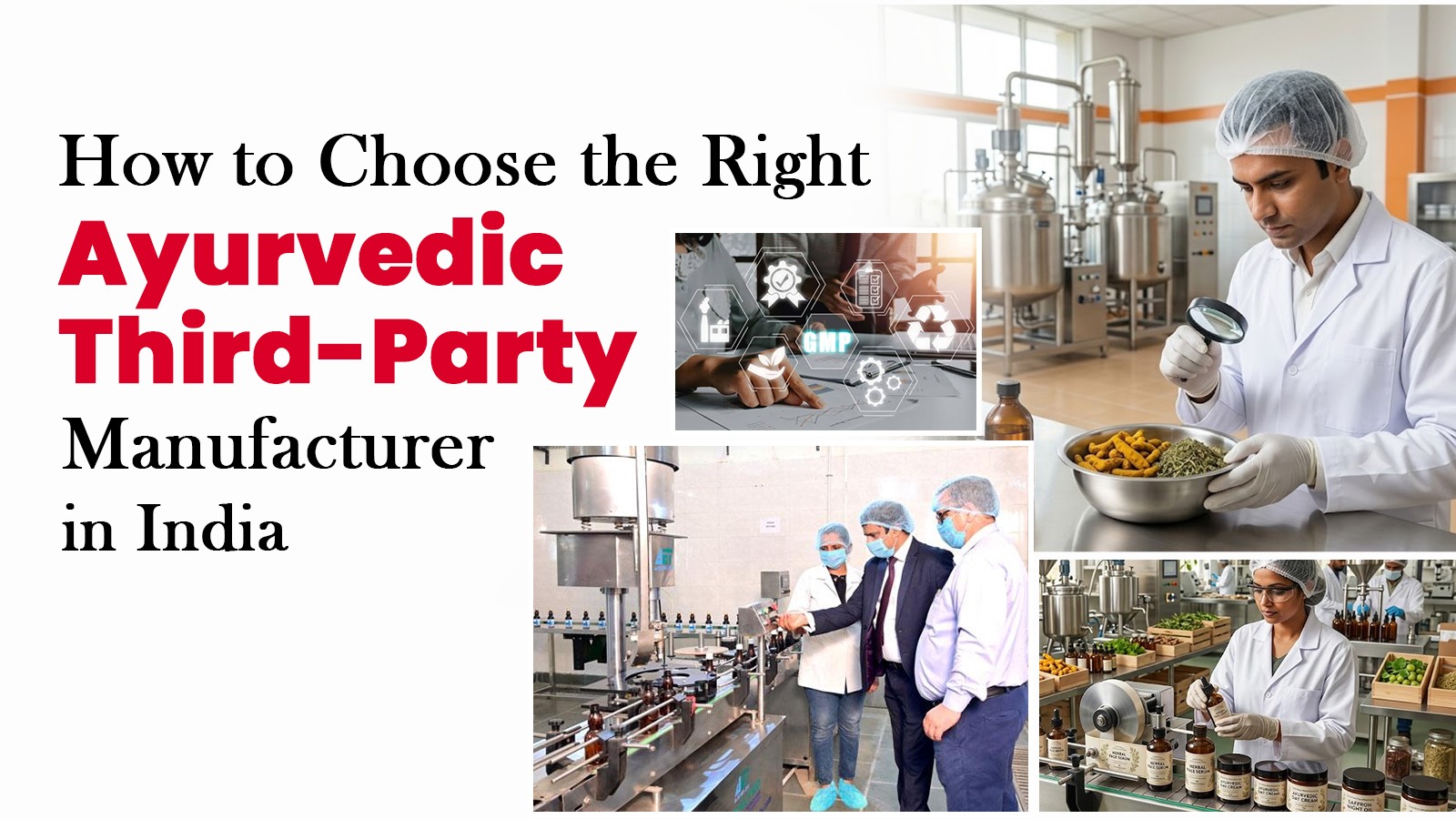
How to Choose the Right Ayurvedic Third-Party Manufacturer in India
Starting an Ayurvedic or herbal product brand can be a promising business opportunity, but choosing the right Ayurvedic Third-Party Manufacturer is one of the most important decisions you will make. A reliable manufacturing partner can help you with product formulation, quality testing, packaging, documentation, and production while allowing you to focus on branding, marketing, and business growth.
With the growing demand for Ayurvedic products in India, businesses need a manufacturing partner that offers quality, consistency, regulatory support, and scalable production. But with many manufacturers available, how do you identify the right one?
This guide explains the key factors you should consider before selecting an Ayurvedic third-party manufacturing partner.
What Is Ayurvedic Third-Party Manufacturing?
Ayurvedic third-party manufacturing is a business model where a specialized manufacturer produces Ayurvedic products for another company or brand.
Instead of investing heavily in your own manufacturing facility, machinery, production team, and quality-control infrastructure, you can partner with an experienced manufacturer. The manufacturer handles production while your business focuses on building the brand and reaching customers.
Depending on your requirements, third-party manufacturing may include:
- Product formulation and development
- Raw material sourcing
- Manufacturing and processing
- Quality testing
- Packaging and labelling
- Product documentation
- Regulatory assistance
- Batch production
- Product delivery
This makes third-party manufacturing a practical option for startups, wellness companies, clinics, doctors, distributors, and established brands looking to expand their Ayurvedic product range.
Why Choosing the Right Manufacturer Matters
Your manufacturing partner directly influences the quality and consistency of your products. Poor manufacturing practices can affect product quality, customer satisfaction, brand reputation, and long-term business growth.
A good manufacturer should have appropriate manufacturing capabilities, quality-control systems, regulatory knowledge, production capacity, and transparent communication.
Therefore, don't choose a manufacturer only because they offer the lowest price. Consider the complete value they provide.
8 Factors to Consider When Choosing an Ayurvedic Third-Party Manufacturer
1. Check Manufacturing Certifications and Licenses
The first step is to verify the manufacturer's applicable licenses, certifications, and regulatory compliance.
For Ayurvedic products, businesses should understand which regulatory requirements apply to their specific product category. A manufacturer should be able to provide relevant documentation and clearly explain its compliance processes.
A GMP-certified manufacturing facility can also demonstrate that the manufacturer follows established Good Manufacturing Practice procedures.
PurshVeda Connect's manufacturing page states that its production facility is GMP certified and AYUSH licensed.
2. Evaluate Product Quality and Testing
Quality should be one of your highest priorities when selecting an Ayurvedic manufacturer.
Ask potential manufacturers:
- How are raw materials checked?
- What quality-control procedures are followed?
- Is batch testing performed?
- Are laboratory reports available?
- Can they provide a Certificate of Analysis (COA)?
- How is product consistency maintained?
PurshVeda Connect highlights multi-stage quality testing and COA documentation for batches produced through its manufacturing services.
3. Look for Formulation and R&D Support
If you want to create a unique Ayurvedic product, formulation support can be extremely valuable.
A capable manufacturer should ideally provide options for both ready-made formulations and customized product development.
Before selecting a partner, ask whether they can:
- Modify an existing formulation
- Develop a custom formulation
- Support ingredient selection
- Help with dosage and product format
- Provide technical guidance
- Develop products according to your target market
PurshVeda Connect offers both ready-formula selection and custom formula development through its manufacturing services.
4. Compare MOQ Requirements
Minimum Order Quantity, or MOQ, is particularly important for startups and new brands.
A high MOQ can tie up significant capital in inventory, while a lower MOQ can make it easier to test products and gradually expand your business.
Before signing an agreement, confirm:
- Minimum quantity per product
- MOQ for custom formulations
- MOQ for different packaging options
- Pricing at different order quantities
- Reorder requirements
PurshVeda Connect states that its manufacturing service offers low-MOQ options, with quantities starting as low as 500 units for most product categories.
5. Check Packaging and Private Label Services
Manufacturing is only one part of launching an Ayurvedic product.
Your partner may also need to support packaging and private labelling. This can simplify the process of creating a complete product ready for your brand.
Look for services such as:
- Bottle and container selection
- Label design
- Carton design
- Packaging support
- Barcode
- QR code
- Product photography
- Product registration assistance
- Export documentation
PurshVeda Connect provides a range of private-label and additional services, including packaging design, bottle selection, label design, barcode, QR code, documentation, photography, and regulatory support.
6. Review the Manufacturer's Product Range
A manufacturer with a broad product portfolio can make it easier to expand your brand in the future.
For example, you may initially launch capsules and later add powders, superfoods, herbal oils, gummies, or other Ayurvedic product categories.
PurshVeda Connect currently showcases a broad catalogue covering categories such as Ayurvedic superfoods, Shilajit, gummies, herbal powders, single-herb capsules, multi-herb capsules, and hair-care products.
A diverse catalogue can give your business more flexibility when planning future products.
7. Understand Production Timelines
Before placing an order, ask the manufacturer about the expected production timeline.
Your delivery schedule may depend on:
- Product type
- Formula availability
- Custom formulation requirements
- Packaging
- Quantity
- Testing
- Label approval
- Documentation
Get the estimated production and delivery timeline in writing so you can plan your marketing campaigns, product launches, and inventory.
PurshVeda Connect describes an eight-step manufacturing process covering consultation, formula selection, quotation, packaging design, manufacturing, quality testing, dispatch, and delivery.
8. Evaluate Communication and Customer Support
Good communication can make the entire manufacturing process much easier.
Your manufacturer should provide clear answers regarding:
- Pricing
- Formulation
- MOQ
- Packaging
- Production status
- Quality testing
- Documentation
- Dispatch
- Delivery
A dedicated project manager or account representative can also help coordinate different stages of the project.
PurshVeda Connect highlights dedicated project-management support as part of its manufacturing offering.
Questions to Ask an Ayurvedic Third-Party Manufacturer
Before finalizing a manufacturer, create a checklist of questions.
Ask:
- What licenses and certifications do you currently hold?
- Is your facility GMP certified?
- What Ayurvedic product categories do you manufacture?
- What is your MOQ?
- Do you offer ready-made formulations?
- Can you develop a custom formulation?
- Do you provide quality testing and COA?
- What packaging options are available?
- Do you provide private-label services?
- What is the estimated production timeline?
- Do you provide regulatory documentation?
- Can you support export requirements?
- How are product samples handled?
- What are the payment terms?
- What support is available after production?
Getting clear answers to these questions can help you compare manufacturers objectively.
Why PurshVeda Connect Can Be Considered for Ayurvedic Manufacturing
PurshVeda Connect provides third-party and private-label Ayurvedic manufacturing support for businesses looking to develop their own Ayurvedic product brands.
Its manufacturing offering includes a GMP-certified unit, AYUSH licensing, 20+ years of stated manufacturing experience, 400+ formulations, custom formula development, low-MOQ options, packaging services, regulatory assistance, quality testing, COA documentation, and PAN India delivery.
The platform also provides an eight-step manufacturing process from consultation and formula selection through manufacturing, quality testing, dispatch, and delivery.
Businesses can therefore discuss their product requirements, select suitable formulations, explore packaging options, and plan production according to their brand requirements.
Third-Party Manufacturing vs. Building Your Own Facility
For many startups and growing brands, third-party manufacturing can reduce the need for major upfront investment in manufacturing infrastructure.
|
Factor |
Third-Party Manufacturing |
Own Manufacturing Facility |
|
Initial investment |
Generally lower |
Generally higher |
|
Manufacturing infrastructure |
Provided by partner |
Requires own investment |
|
Production team |
Manufacturer-managed |
Must be hired and managed |
|
Quality control |
Managed with manufacturer |
Managed internally |
|
Scalability |
Can be flexible |
Requires additional infrastructure |
|
Product development |
May be available through partner |
Requires own R&D capabilities |
|
Operational responsibility |
Shared/outsourced |
Mostly internal |
The best choice depends on your business size, budget, product requirements, production volume, and long-term strategy.
Red Flags to Avoid When Selecting a Manufacturer
Be careful if a manufacturer:
- Cannot clearly explain its manufacturing credentials
- Avoids providing relevant documentation
- Offers extremely low prices without explaining the difference
- Has unclear quality-testing procedures
- Cannot provide product specifications
- Has inconsistent communication
- Cannot clearly define MOQ and production timelines
- Provides vague payment or delivery terms
Always conduct proper due diligence before committing to a long-term manufacturing relationship.
Final Checklist for Choosing the Right Manufacturer
Before making your final decision, evaluate the manufacturer based on:
- Licensing & compliance
- GMP and quality systems
- Product expertise
- Formulation capabilities
- Quality testing
- COA and documentation
- MOQ
- Packaging options
- Private-label support
- Production capacity
- Delivery timelines
- Pricing transparency
- Customer support
- Scalability
The right Ayurvedic Third-Party Manufacturer should be more than just a supplier. Ideally, they should become a reliable production partner who can support your brand from product development to delivery.
Final Thought
Choosing the right Ayurvedic Third-Party Manufacturer is an important step toward building a successful Ayurvedic product brand. Instead of focusing only on price, evaluate quality, certifications, formulation capabilities, MOQ, packaging, testing, documentation, production capacity, and customer support.
For startups, clinics, wellness businesses, distributors, and established brands, a reliable third-party manufacturing partner can make it easier to develop and scale an Ayurvedic product portfolio.
PurshVeda Connect offers third-party and private-label manufacturing services with formulation, packaging, quality testing, regulatory support, and delivery assistance. Businesses can explore the available manufacturing options and discuss their specific requirements before starting production.
Frequently Asked Questions
1. What is an Ayurvedic Third-Party Manufacturer?
An Ayurvedic Third-Party Manufacturer produces Ayurvedic products for another business or brand. The brand can focus on branding, marketing, distribution, and sales while the manufacturing partner manages production according to the agreed requirements.
2. How do I choose the best Ayurvedic Third-Party Manufacturer in India?
Check the manufacturer's applicable licenses, GMP compliance, quality-control systems, product range, formulation capabilities, MOQ, packaging services, documentation, production capacity, delivery timelines, and reputation.
3. Is GMP certification important for Ayurvedic manufacturing?
Yes. GMP, or Good Manufacturing Practice, is an important consideration when evaluating an Ayurvedic manufacturing facility. Businesses should verify the manufacturer's current applicable certifications and regulatory credentials.
4. Can an Ayurvedic manufacturer create a custom formulation?
Yes, some manufacturers provide custom formulation and R&D services. PurshVeda Connect states that it offers custom formula development along with ready-to-manufacture formulations.
5. What is MOQ in Ayurvedic third-party manufacturing?
MOQ stands for Minimum Order Quantity. It is the minimum number of units that a manufacturer requires for a production order. MOQ can vary depending on the product, formulation, packaging, and manufacturing requirements.
6. Can startups use third-party Ayurvedic manufacturing?
Yes. Third-party manufacturing can be a practical option for startups because it can reduce the need to establish their own manufacturing infrastructure. Startups should compare MOQ, pricing, quality systems, documentation, and scalability before selecting a partner.
7. Does third-party manufacturing include packaging?
It can. Depending on the manufacturer and agreement, services may include bottle selection, label design, carton design, packaging, barcodes, QR codes, and other private-label services. PurshVeda Connect offers several of these services.
8. Can Ayurvedic manufacturers provide quality reports?
Many manufacturers provide quality documentation depending on the product and applicable requirements. PurshVeda Connect states that it provides multi-stage quality testing with Certificate of Analysis (COA).
9. How long does Ayurvedic third-party manufacturing take?
The timeline depends on factors such as product selection, formulation, packaging, quantity, testing, and documentation. Always ask the manufacturer for a project-specific production and delivery timeline before placing an order.
10. Why should I choose PurshVeda Connect for Ayurvedic third-party manufacturing?
PurshVeda Connect offers third-party and private-label manufacturing support, including formulation options, packaging services, quality testing, regulatory assistance, and delivery support. Its manufacturing page also highlights 20+ years of stated experience, 400+ formulations, GMP-certified production, and low-MOQ options.

Comments ( 0 )
Leave A Comment